





Before putting a new skin-care product over your whole face, try it on a small area according to its directions. A home use test can reveal a reaction before a wider application. It cannot prove that a product is allergy-free, diagnose an allergy, or guarantee that your face will tolerate it.
Know what a home test can tell you
DermNet explains that medical patch testing investigates substances that cause allergic contact dermatitis. It requires the right test materials and interpretation. Trying a finished cosmetic at home answers a narrower question about using that product. DermNet: patch testing
| Process | Question it addresses | Limit |
|---|---|---|
| Small-area home use test | Does this product produce a noticeable reaction at this spot during the test? | A quiet test area does not guarantee tolerance elsewhere or with continued use. |
| Medical patch testing | Could a particular allergen explain the dermatitis? | Requires professional selection, interpretation, and follow-up. |
If you already have a known allergy, check ingredients first. Do not deliberately test a known trigger to see whether your skin has changed.
Read the label before choosing a test
Check whether the product stays on or rinses off, where it may be used, and any warnings. This guide concerns ordinary cosmetics used on intact skin. A peel, hair dye, medicine, or product with specific safety-test directions needs its own instructions; do not substitute this routine.
Claims such as “hypoallergenic” are not a personal guarantee. The FDA explains that cosmetic allergen labeling has limits, including fragrance mixtures that may appear under a collective ingredient name. A package’s ingredient list is useful, but it does not identify every possible individual trigger for you. FDA cosmetic-allergen information
“Unscented” and “fragrance-free” also deserve a closer label check. Marketing language and how strongly a product smells cannot tell you every ingredient in it. If the list leaves you with a question, the FDA recommends contacting the manufacturer rather than relying on the front-of-package wording.
Follow a small-area test carefully
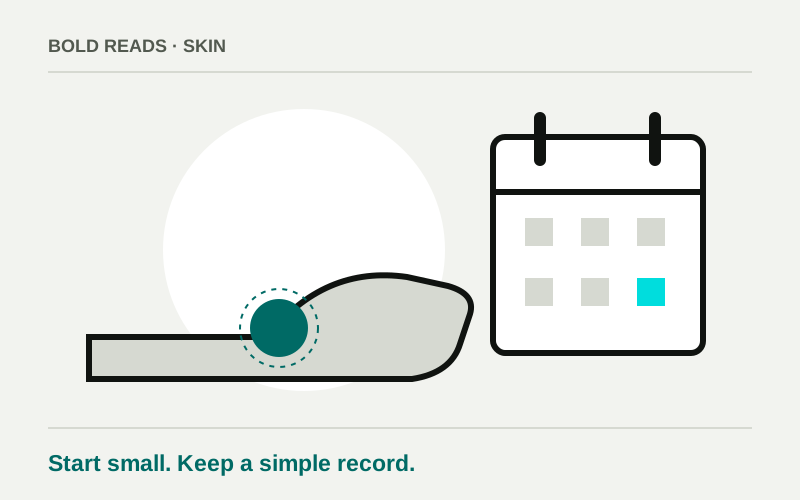
For a new ordinary cosmetic, the American Academy of Dermatology (AAD) suggests a quarter-sized spot on the underside of the arm or elbow, the normal amount, twice daily for seven to ten days. For a rinse-off product, follow its contact-time and rinsing directions. Do not leave a cleanser on as though it were a moisturizer. Small-area method
Keep the test straightforward:
- Choose intact skin and follow the product’s restrictions.
- Keep the product name and ingredient list available.
- Note the start date and where you applied it.
- Watch for itching, swelling, discomfort, or a new skin change.
- If a reaction develops, wash the product off and stop using it.
Do not extend or repeat a test to push through a reaction. The AAD advises stopping and seeking a dermatologist’s help if the reaction is severe or does not settle.
Introduce one product into a stable routine
After a test without a noticeable reaction, follow the label when introducing the product to its intended area. Keep your other steps familiar. Buying a cleanser, serum, and moisturizer together does not mean you need to start all three together.
A simple log can contain four things: product, date introduced, area used, and what you noticed. This makes it easier to describe a problem and show a clinician the relevant labels. It is not a way to diagnose a reaction yourself.
Start with a clear purpose, such as replacing a cleanser you find uncomfortable or adding a moisturizer where skin feels dry. Our simple oily and combination-skin routine helps organize those basics before adding extra steps.
Know when to stop experimenting
Contact dermatitis can result from irritation or an allergy, and symptoms can appear after exposure rather than immediately. Skin changes may look red on lighter skin and brown, purple, or grey on darker skin. The NHS advises assessment for persistent, recurrent, or severe symptoms. Contact-dermatitis guidance
Keep the product packaging and your short timeline. Avoid layering several new products over a reaction or trying the same suspected trigger repeatedly. A clinician can decide whether allergy testing or a different explanation needs investigation.
Sources and further reading
- AAD — testing new skin-care products.
- DermNet — medical patch testing.
- FDA — allergens in cosmetics.
- NHS — contact dermatitis.
General cosmetic-use guidance. Home testing does not diagnose an allergy or replace product-specific safety instructions.